
Rainforest Green Marble is one of the most visually striking natural stones on the market — and one of the most misunderstood. Sold commercially as a “marble,” it is in fact a serpentinite, a metamorphic rock with a mineral makeup, hardness profile, and chemical behavior that differ meaningfully from true calcite marble. That distinction isn’t academic: it directly affects how a Rainforest Green Marble slab should be fabricated, sealed, and maintained, and whether a Rainforest Green Marble countertop is the right call for a given space. This guide breaks down the stone at a technical level — geology, mineralogy, hardness, porosity, and acid sensitivity — then translates that data into practical guidance for specifying, buying, and living with this material.
What Is Rainforest Green Marble?
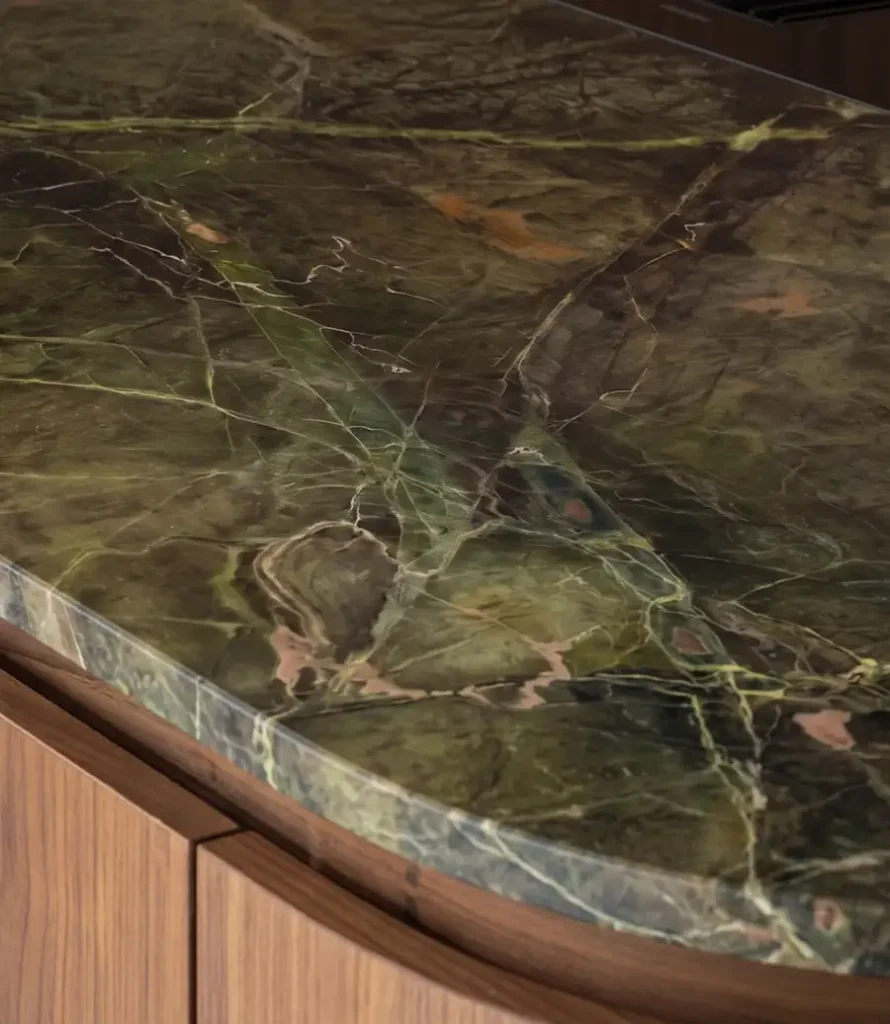
Rainforest Green Marble is a natural stone quarried primarily in the Bidasar region of Rajasthan, India, which is why it also appears in trade catalogs as Bidasar Green or Vidasar Green Marble. Its defining feature is a dense, tangled network of brown, gold, and maroon veining set against a mottled green field — a pattern that resembles a forest canopy viewed from above, which is where the trade name originates.
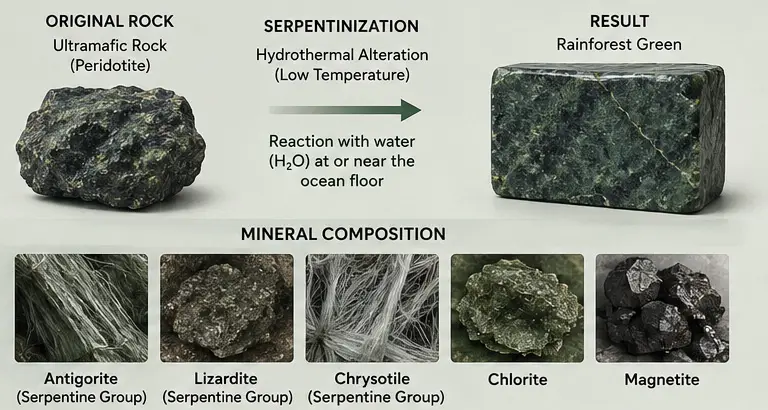
Geology: Why It’s Technically a Serpentinite, Not a True Marble
True marble is a metamorphic rock formed from the recrystallization of limestone or dolostone, and it’s overwhelmingly composed of calcite (CaCO₃). Rainforest Green, by contrast, forms through serpentinization — a low-temperature hydrothermal alteration process in which olivine- and pyroxene-rich ultramafic rock reacts with water, typically at or near the ocean floor, and converts into serpentine-group minerals (antigorite, lizardite, and chrysotile) along with chlorite and magnetite.
This distinction matters for three practical reasons:
1. Mineral hardness: Serpentine minerals sit differently on the Mohs scale than calcite, giving the stone a somewhat different scratch and wear profile than classic calcite marble.
2. Chemical reactivity: Serpentinite is a magnesium silicate rather than a calcium carbonate rock, so its response to acidic contact differs from true marble — though it is not immune to etching and should still be treated as acid-sensitive in any kitchen application.
3. Fabrication behavior: Serpentinite is denser and tougher to cut and polish than calcite marble, which affects lead times and tooling at the fabrication stage.
The trade continues to call it “marble” because that’s how it’s classified commercially in the dimension stone industry (per ASTM C503 usage conventions, “marble” is often applied broadly to any calcareous or serpentine ornamental stone that takes a polish), but a technically accurate spec sheet should note its serpentinite composition.
Visual & Aesthetic Characteristics
When specifying a Rainforest Green Marble slab, a few technical details determine whether the material will perform and look as expected:
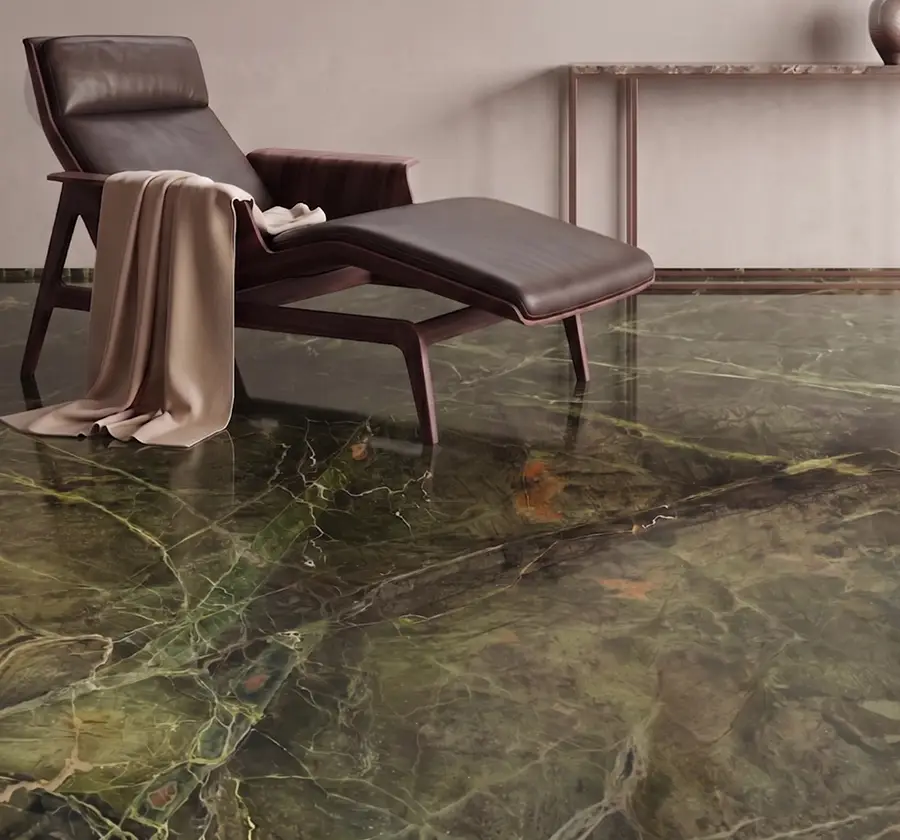
● Veining: Dense, branching veins in brown, gold, rust, and occasional cream or white, running through the field in irregular, organic patterns — no two slabs are identical.
● Base color: Forest green, ranging from deep olive to a lighter, yellow-green tone depending on the block and quarry lot.
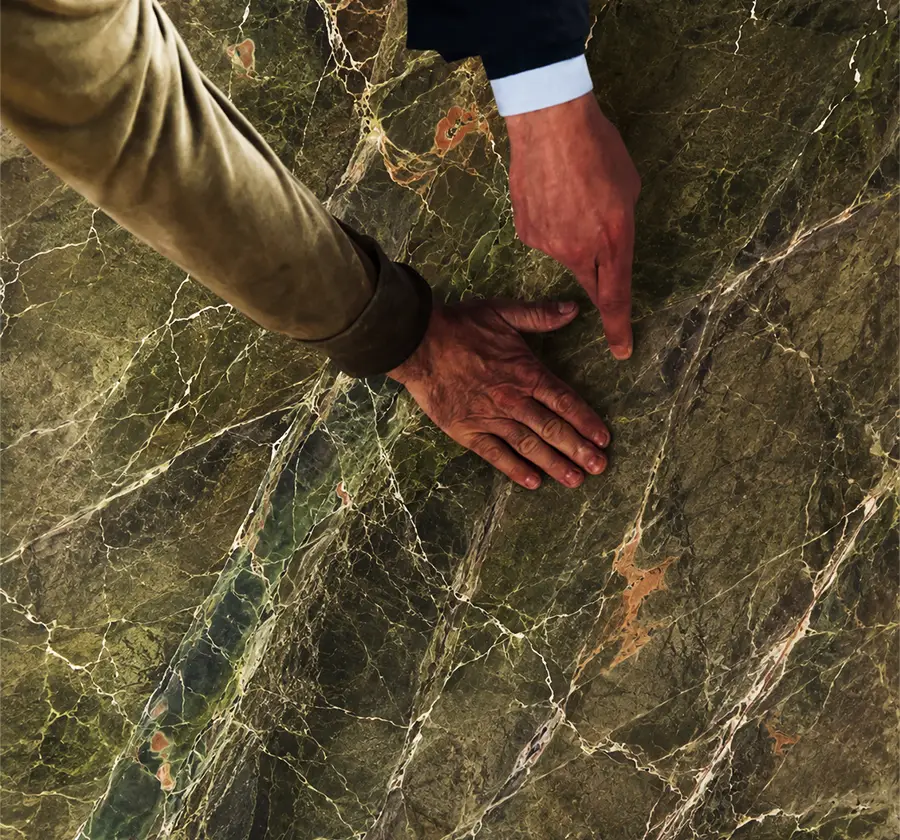
● Pattern movement: High-movement stone; best suited for those looking for book-matched installations (waterfall islands, feature walls) where the veining can run continuously across a seam.
● Finish options: Polished (high gloss, deep color saturation), honed (matte, softer look, hides etching more effectively), and other specialty finishes such as flamed, leathered, or brushed, mainly used for flooring & cladding.
Technical Properties: Hardness, Porosity, and Durability
| Property | Rainforest Green Marble (Serpentinite) | Calcite Marble | Granite |
| Primary minerals | Serpentine group, chlorite, magnetite | Calcite | Quartz, feldspar, mica |
| Relative hardness | Moderately hard; tougher than most calcite marbles | Softer, more scratch-prone | Hardest of the three |
| Acid/etch sensitivity | Lower than calcite marble, but not acid-proof | High — etches readily with citrus, vinegar, wine | Very low |
| Porosity | Low to moderate | Moderate to high | Low |
| Heat tolerance | Good | Good | Excellent |
| Typical slab thickness | 2 cm (3/4″) and 3 cm (1 1/4″) | 2 cm and 3 cm | 2 cm and 3 cm |
Practical takeaway: Rainforest Green performs closer to a “tough marble” than a granite substitute. It holds up better to daily wear than many calcite marbles, but it still requires sealing and acid-aware maintenance — it is not a maintenance-free surface.
Rainforest Green Marble Slab: Sourcing, Grading, and Specification
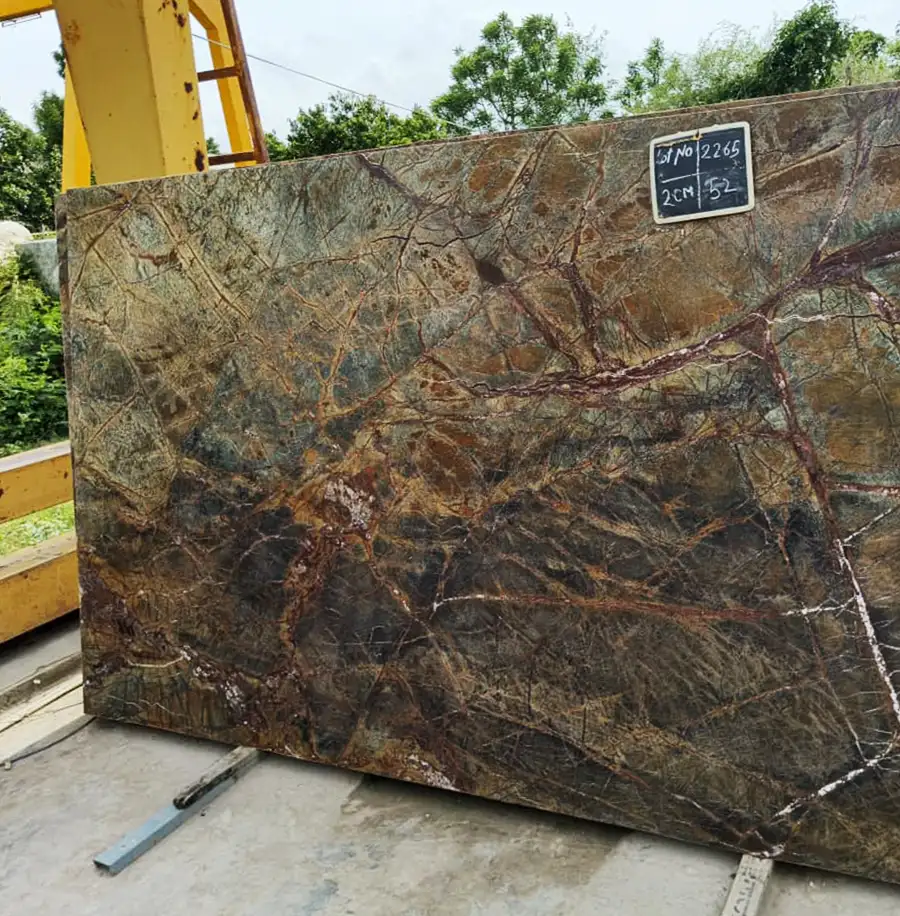
When specifying a Rainforest Green Marble slab, a few technical details determine whether the material will perform and look as expected:
● Block consistency: Because the stone forms through an irregular geological process, veining density and color saturation vary significantly between blocks — and sometimes within the same block. Always select from the actual slab lot being purchased, not a catalog photo.
● Fissures and natural voids: Serpentinite can carry small natural fissures. Reputable fabricators fill these with resin during the processing and back most slabs with a fiberglass mesh for overall structural stability, especially at 2 cm thickness.
● Resin treatment: Most commercial Rainforest Green slabs are resin-treated (a standard industry process for both marble and serpentinite) to improve stain resistance and stabilize hairline fissures. Ask your supplier to confirm treatment status.
● Slab dimensions: Standard slabs typically range from 106″ x 63″ to 118″ x 78″, though this varies by quarry & block size — request exact dimensions before ordering for large-format or book-matched layouts. ● Finish and thickness: Specify polished vs. honed and 2 cm vs. 3 cm at the time of order, since re-polishing on site can alter color depth.
Rainforest Green Marble Countertop: Suitability & Design Guidance
A Rainforest Green Marble countertop is a design-forward choice best suited for spaces where visual impact outweighs the need for a maintenance-free surface.
Where it performs well:
- Bar tops & butler’s pantries
- Kitchen islands (used primarily as a design feature rather than the main prep surface)
- Fireplace surrounds & backsplashes, where the stone functions more as cladding than a work surface
- Bathroom vanity tops (lower exposure to acidic spills than kitchens)
Where to plan around its limits:
- Primary kitchen prep zones with frequent citrus, wine, or vinegar contact — pair with a cutting board & immediate wipe-down habits, or route heavy prep to an adjacent granite or quartz section.
- High-traffic commercial kitchens, where a sealed yet porous stone will require a stricter maintenance schedule than engineered surfaces.
Design pairing notes:
- Contrasts well with matte black, dark walnut, and brushed brass fixtures, which let the green-and-gold veining read as the visual anchor.
- Honed finishes are a practical choice for kitchen use since they hide minor etching better than high-polish finishes.
Maintenance and Care
1. Seal on installation and re-seal on the schedule your fabricator recommends (typically annually for kitchen use, less frequently for vanities).
2. Use pH-neutral, stone-safe cleaners only — avoid vinegar, citrus-based cleaners, ammonia, and bleach, all of which can etch the surface.
3. Wipe acidic spills immediately — wine, coffee, tomato sauce, and citrus juice are the most common causes of etching on any marble-family stone.
4. Use trivets and cutting boards — while more heat- and scratch-tolerant than calcite marble, it is not a substitute for granite or engineered quartz in heavy-use prep zones.
5. Dust with a soft microfiber cloth regularly to prevent grit from dulling the polish over time.
Frequently Asked Questions
Q: Is Rainforest Green Marble a real marble?
A: Not geologically. It’s a serpentinite, a distinct metamorphic rock, but it’s classified and sold commercially as marble due to industry convention and its calcite-marble-like polish and appearance.
Q: Is Rainforest Green Marble good for kitchen countertops?
A: It can be used for kitchen countertops, particularly islands and accent areas, but it behaves like marble in terms of acid sensitivity. It’s a better option for design-forward spaces than for a primary high-acid application surface.
Q: Does Rainforest Green Marble need to be sealed?
A: Yes. Like other marble-family stones, it is porous enough to require sealing at installation and periodic resealing to resist staining.
Q: What are other names for Rainforest Green Marble?
A: It’s also sold as Bidasar Green Marble, Vidasar Green Marble, and Rain Forest Green.
Q: Where is Rainforest Green Marble quarried?
A: Primarily in the Bidasar region of Rajasthan, India.
Ready to source a Rainforest Green Marble from India?
Regatta Universal Exports is an ISO-certified natural stone manufacturer and exporter based in New Delhi, India. With over 25 years of experience and supply to 60+ countries, we offer granite, marble, and quartzite countertops in custom sizes, finishes, and edge profiles. Share your requirement, preferred stone type, size, and finish — and our team will respond with pricing and samples at the earliest.