
Green marble has a character that few other natural stones can reproduce. Some varieties have deep emerald backgrounds crossed by fine white veins. Others display dramatic brown, grey, and golden patterns that resemble tree branches spreading across a forest floor.
That natural variation is precisely what makes green marble appealing. It can turn an ordinary wall into a focal point, give a bathroom a distinctive identity, or bring depth & warmth to a commercial interior.
However, selecting green marble involves more than choosing an attractive colour.
For architects, importers, contractors, and natural stone distributors, the material’s geological composition, surface finish, slab dimensions, and pattern consistency are equally important.
India is a recognised source of green decorative marble, with Rajasthan supplying several commercially important varieties.
This guide explores the main types of Indian green marble, their architectural applications, available finishes, maintenance requirements, and the factors international buyers should consider before ordering.
What Is Green Marble?
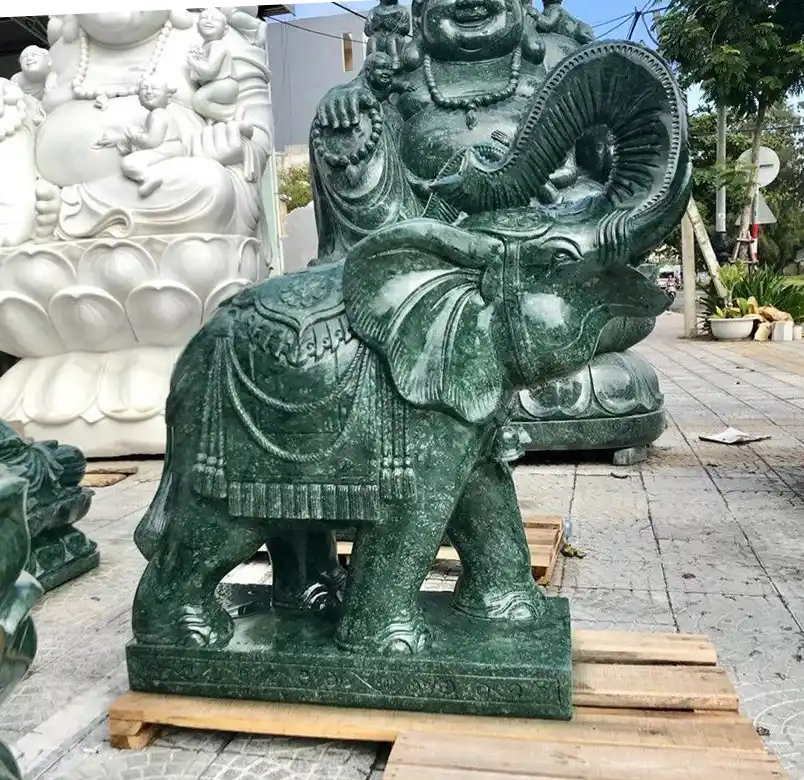
Green marble is a commercially recognised category of natural decorative stone characterised by green mineral colouring and distinctive veining. It is supplied in the form of slabs, tiles, blocks, countertops, and cut-to-size architectural products.
Its appearance ranges from light grey-green and sage tones to deep forest green, sometimes combined with white, brown, or gold-coloured veins.
An important distinction is that not every stone sold as green marble is geologically classified as marble.
Traditional marble forms when limestone or dolostone undergoes metamorphism. Several commercially available Indian green marbles, however, contain substantial quantities of serpentine minerals.
These stones may be geologically classified as serpentinite or serpentine-rich rocks while continuing to be sold as marble within the natural stone industry.
The distinction matters because mineral composition influences how a stone responds to scratching, polishing, staining & acidic substances.
For architectural specifications, buyers should confirm the actual material type rather than relying entirely on its commercial name.
Where Does Green Marble Come From in India?
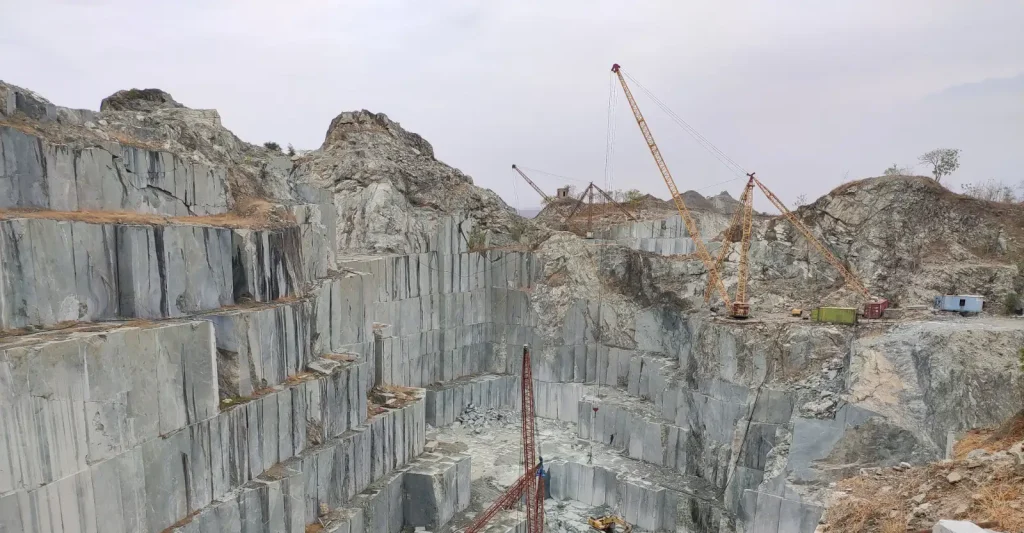
Rajasthan is one of India’s most established marble-producing states and an important source of green decorative stone.
The Udaipur, Dungarpur, and surrounding quarry regions are associated with several varieties of green serpentine-rich marble.
Bidasar in Rajasthan is particularly recognised in the natural stone trade for its strongly patterned Rainforest Green Marble.
These regional differences contribute to the variety of colours and patterns available in the Indian market.
However, a quarry location does not guarantee identical-looking material.
Two blocks extracted from the same quarry can differ noticeably in colour distribution, veining, and internal structure. Even slabs cut from a single block may show changes in movement and pattern.
For large projects, selecting material from an identified production lot is often more useful than choosing a variety based only on a catalogue photograph.
Popular Types of Indian Green Marble
Indian green marble includes several varieties with different visual characteristics. The right choice depends on the architectural setting, desired pattern, surface finish, and project requirements.
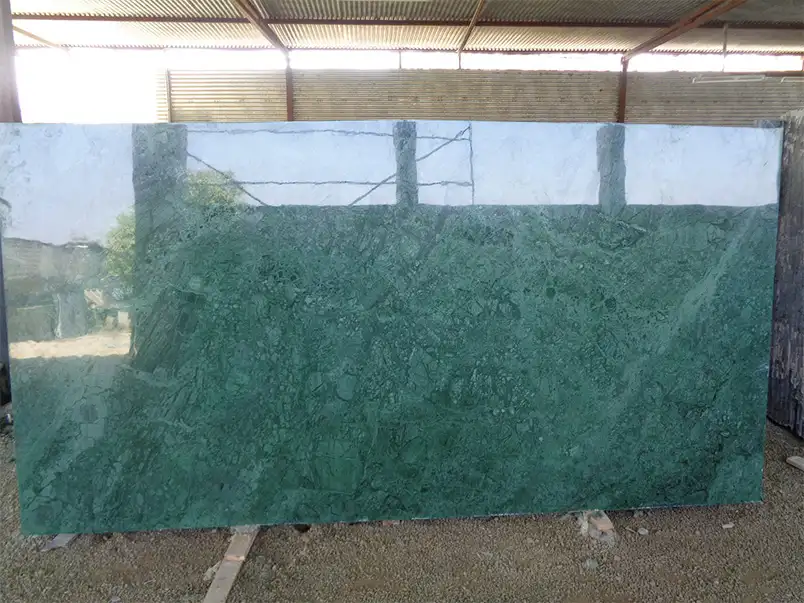
1. Forest Green Marble
Forest Green Marble is recognised for its green background and irregular dark green or brown veining.
The pattern often resembles branches spreading through dense foliage.
Rather than displaying a uniform surface, this stone creates a sense of natural movement, particularly across large slabs.
Common applications: Feature walls, vanity tops, countertops, wall cladding, and decorative architectural elements.
Design consideration: Forest Green Marble works particularly well where its veining can remain visible across a large uninterrupted surface.
When ordering multiple slabs, buyers should examine the actual lot to understand how the pattern changes from one piece to another.
2. Rainforest Green Marble
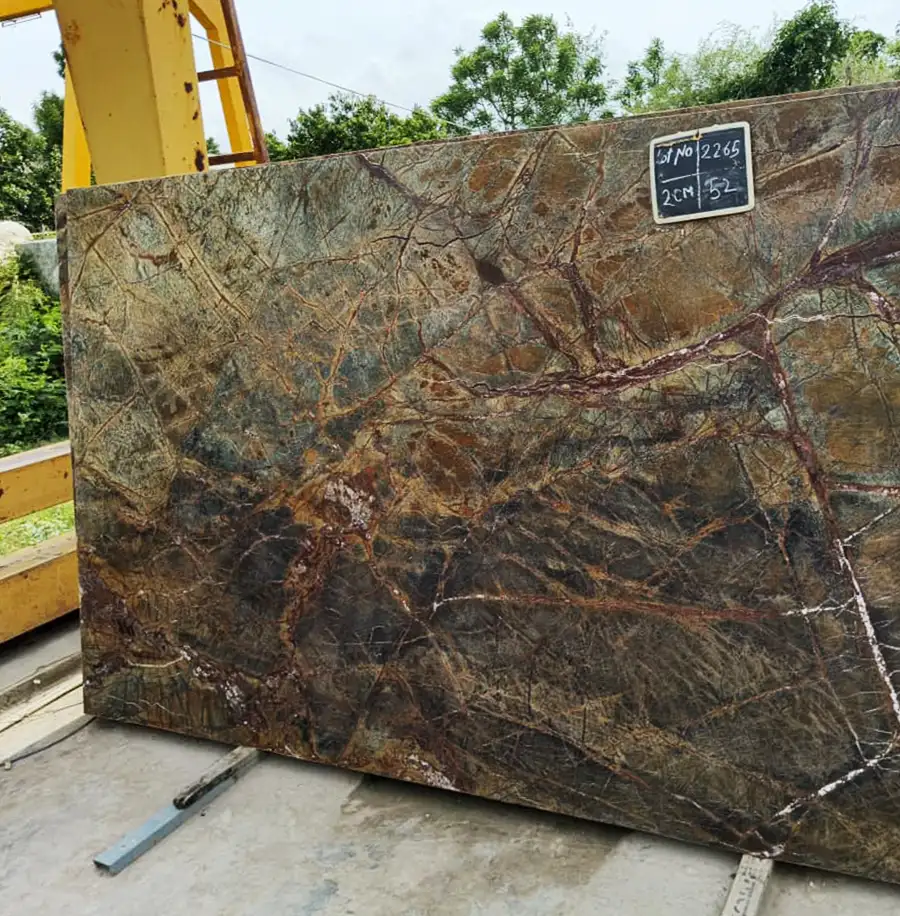
Rainforest Green Marble, also commercially known as Bidasar Green Marble, is among the most recognisable decorative stones from Rajasthan.
Its green background features an irregular network of brown and darker mineral veins.
These contrasting lines produce a distinctive forest-like appearance.
The combination of natural colour variation and dramatic veining makes the stone suitable for projects where the surface itself is intended to become a major design feature.
Common applications: Reception walls, bathroom interiors, countertops, flooring & statement wall panels.
Design consideration: Slab selection is especially important for large installations because the veining can vary significantly.
Forest Green & Rainforest Green may also be used as overlapping trade descriptions. Buyers should confirm the actual material and slab photographs before ordering.
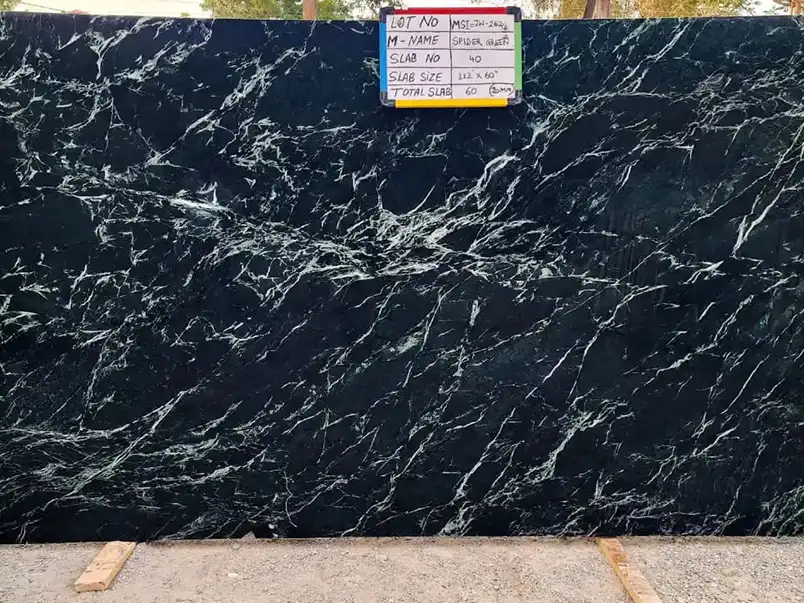
3. Spider Green Marble
Spider Green Marble offers a different appearance.
It typically features a green background crossed by thin, light-coloured veins that resemble a spider’s web.
Compared with heavily patterned forest varieties, its veining often appears finer and more closely distributed.
This makes it an interesting option for interiors requiring a dark natural stone with a contrasting surface pattern.
Common applications: Flooring, bathroom vanities, wall cladding, staircases, and decorative panels.
Design consideration: The density and direction of the white veins should be checked across the selected lot, especially when creating a continuous installation.
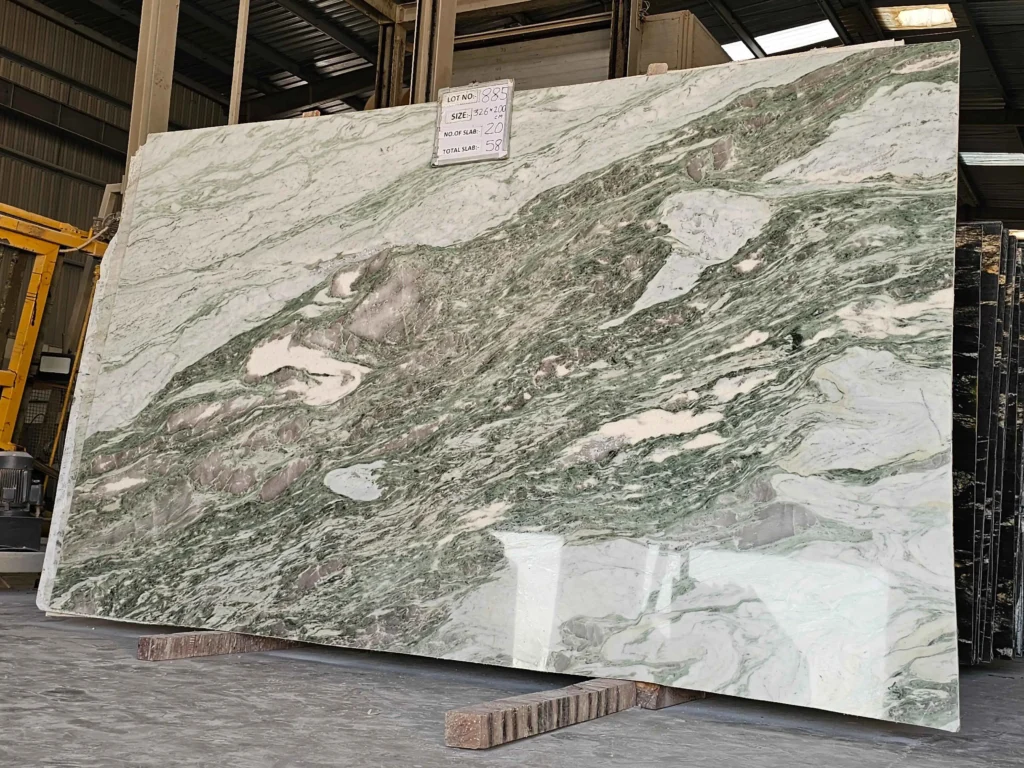
4. Valley Green Marble
Valley Green Marble combines green tones with streaks of brown, grey, and lighter mineral colours.
Its appearance can vary from relatively subdued to strongly patterned, depending on the block.
The mixture of colours makes it suitable for interiors combining natural wood, neutral finishes, and metal accents.
Common applications: Interior flooring, wall panels, countertops & decorative surfaces.
Design consideration: Buyers should compare full-slab photographs rather than relying on small samples, as larger pieces reveal the overall direction and scale of the veining.
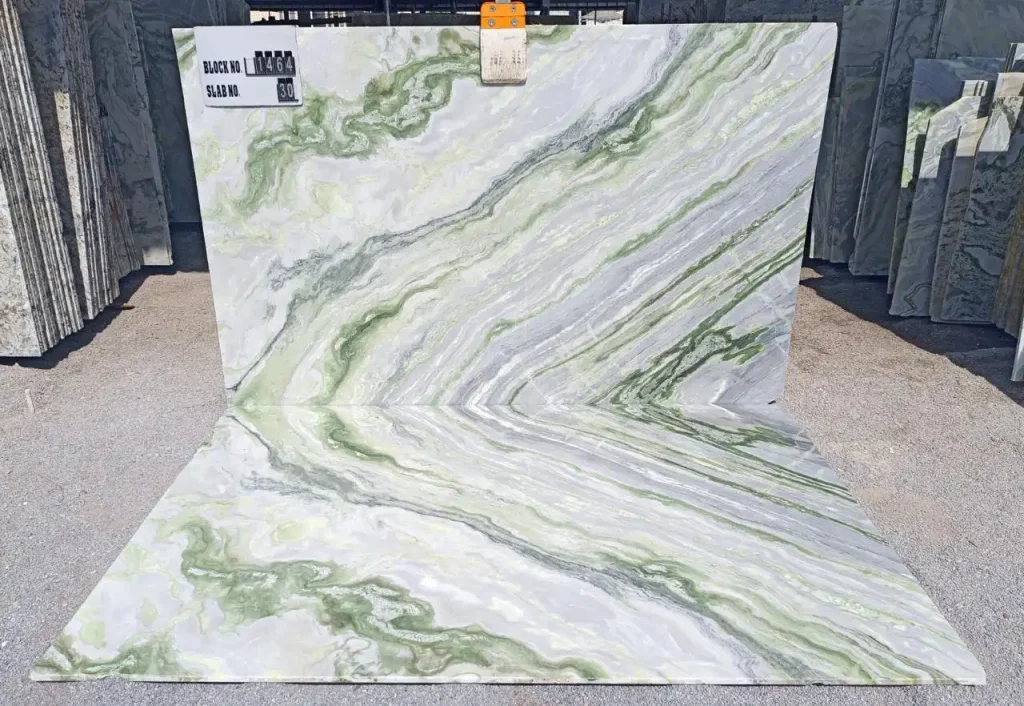
5. Himalayan Green Marble
Himalayan Green Marble is characterised by soft grey-green colouring with flowing bands of lighter green and grey.
Its appearance is noticeably different from the branch-like patterns associated with Rainforest Green.
Selected material may also offer decorative possibilities for illuminated installations, depending on its translucency and thickness.
Common applications: Feature walls, vanity tops, reception counters, decorative panels, and selected backlit installations.
Design consideration: When specifying this material for backlighting, buyers should examine samples under the intended lighting conditions. Not every slab will transmit light in the same way.
Not every slab will transmit light in the same way.
Which Green Marble Is Best for Your Project?
Different applications place different demands on a natural stone surface.
| Application | Suitable consideration | What buyers should check |
|---|---|---|
| Feature walls | Rainforest Green or Forest Green | Veining, slab matching, visual continuity |
| Interior flooring | Spider Green or selected green marble varieties | Abrasion resistance, finish, slip performance |
| Bathroom vanities | Forest Green, Spider Green, Valley Green | Water exposure, sealing requirements |
| Kitchen countertops | Carefully selected green marble | Scratch resistance, staining, acid sensitivity |
| Reception counters | Rainforest Green or Himalayan Green | Pattern orientation, fabrication details |
| Decorative panels | Forest Green or Himalayan Green | Slab dimensions, colour, translucency where required |
These recommendations are based on visual suitability, not a guarantee of technical performance.
Final material selection should consider the specific stone, installation environment, and relevant performance test results.
Architectural Applications of Green Marble
1. Green Marble Flooring
Green marble flooring brings a distinctive colour palette into residential and commercial interiors.
It can work particularly well with neutral walls, timber furniture, and understated decorative elements.
For large flooring projects, the main challenge is achieving a balanced distribution of natural veining.
Individual tiles may look attractive on their own but create an uneven appearance when installed together without planning.
A dry-lay arrangement, where tiles are positioned before installation, helps designers assess colour variation and pattern continuity.
The selected finish must also meet the slip-resistance requirements of the installation area.
2. Green Marble Wall Cladding
Wall cladding is one of the most effective applications for highly patterned green marble.
Because vertical surfaces generally experience less abrasive wear than floors or worktops, designers can focus more heavily on the material’s decorative qualities.
Large slabs can create impressive feature walls in hotel lobbies, living rooms, offices, and reception areas.
For particularly expressive materials, bookmatching can create a symmetrical pattern by arranging adjacent slab faces as mirror images.
Bookmatching should be planned during slab selection and cutting rather than assumed to be possible with any two finished slabs.
3. Green Marble Kitchen Countertops
Green marble countertops are often selected for their rich colour and distinctive appearance.
They can provide a striking contrast to light cabinetry, natural wood, and neutral interior finishes.
However, appearance should not be the only consideration.
Different green marble varieties have different mineral compositions and surface performance characteristics.
Some green marble varieties can be highly susceptible to scratching, staining, or surface damage from acidic substances.
For kitchens involving frequent food preparation, buyers should confirm the specific stone’s suitability & its maintenance requirements.
A protective sealer may help reduce staining, but it does not make natural stone completely stain-proof or prevent all forms of surface damage.
4. Green Marble Bathrooms
Green marble can create a sophisticated bathroom environment without requiring a complicated colour scheme.
A single green marble vanity top or feature wall can provide sufficient visual interest when combined with neutral sanitaryware.
For bathrooms, surface treatment & water management are important.
Stone selection should account for moisture exposure, cleaning products, installation details, and slip resistance where the material is used on floors.
5. Commercial Interiors & Hospitality Projects
Hotels, restaurants, offices, and retail environments frequently use natural stone to create identifiable architectural features.
Green marble can be particularly effective for reception desks, decorative walls, bar fronts, and selected interior flooring.
In large commercial projects, material consistency becomes a procurement consideration.
The same variety may be required across several installation phases.
Where possible, allocating sufficient material from an approved lot can help reduce noticeable differences between project areas.
Green Marble Finishes: Which One Should You Choose?
The finish changes both the appearance and the practical characteristics of green marble.
1. Polished Finish
A polished finish produces a smooth, reflective surface.
It often makes the stone’s colour appear deeper and brings contrasting mineral veins into sharper focus.
This finish is commonly considered for feature walls, vanity tops, and decorative interior applications.
2. Honed Finish
Honed marble has a smoother, less reflective appearance.
It can provide a more understated look while retaining the stone’s natural colour and movement.
Honed finishes are frequently considered for contemporary interiors where a highly reflective surface is not desired.
3. Leathered & Brushed Finishes
Leathered & brushed finishes introduce subtle surface texture.
They can give selected green marble varieties a more tactile appearance, particularly in decorative interior applications.
Availability depends on the material and the processing method.
4. Sandblasted Finish
Sandblasting creates a textured surface by treating the stone with abrasive particles.
This may be considered for certain architectural applications where a rougher finish is required.
However, the resulting surface characteristics must be evaluated for the intended use.
Important: A textured finish should never be assumed to provide adequate slip resistance without appropriate testing.
Green Marble vs Green Granite: What Is the Difference?
Green marble and green granite can both be used to introduce natural green tones into architectural spaces.
However, they are not interchangeable materials.
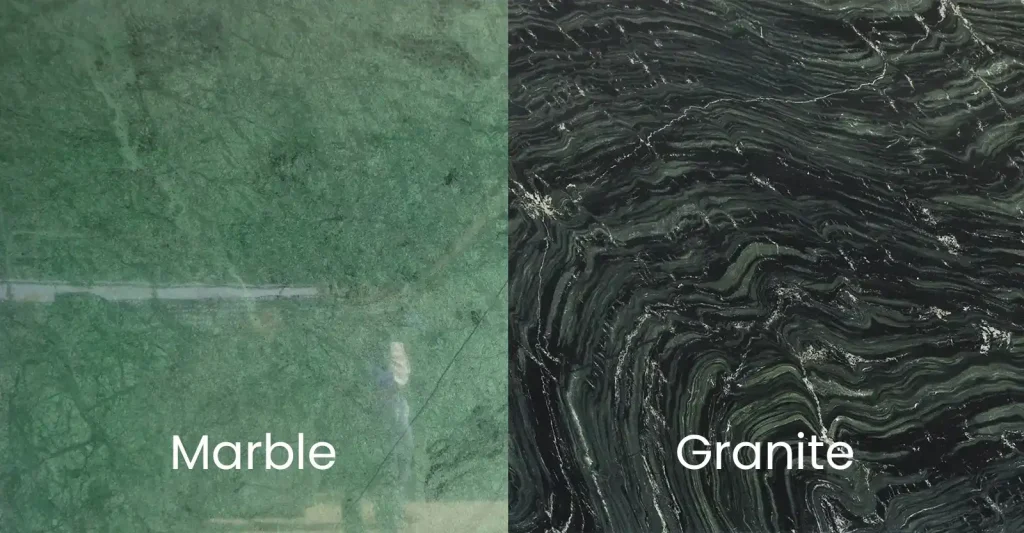
| Feature | Green Marble | Green Granite |
|---|---|---|
| Appearance | Often displays flowing veins and irregular mineral patterns | Frequently has granular, speckled, or crystalline patterns |
| Geological composition | Varies; may include carbonate or serpentine-rich stone | Generally composed of minerals including quartz and feldspar |
| Scratch resistance | Depends on the specific variety | Generally offers higher scratch resistance |
| Acid sensitivity | Depends on mineral composition; some varieties are sensitive | Generally more resistant to common household acids |
| Maintenance | May require more careful surface protection | Typically more forgiving in demanding applications |
| Design appeal | Particularly suited to expressive decorative surfaces | Suitable for decorative and demanding functional surfaces |
For decorative walls and statement installations, green marble may be preferred for its expressive veining.
For heavily used kitchen countertops or certain commercial applications, suitable green granite varieties may offer practical advantages.
The final decision should depend on the material’s verified properties rather than colour alone.
Available Green Marble Slab Sizes and Formats
Indian green marble is supplied in several commercial formats to meet different fabrication and construction requirements.
Typical catalogue formats include:
| Product | Indicative dimensions |
|---|---|
| Gangsaw slabs | Approximately 280 × 180 cm and above |
| Cutter slabs | Approximately 180 × 60 cm and above |
| Standard slab thickness | Commonly 2 cm and 3 cm |
| Marble tiles | 30 × 30, 30 × 60, 60 × 60 cm |
| Large-format tiles | 60 × 90 and 60 × 120 cm |
| Countertops | Custom dimensions |
| Cut-to-size products | According to project drawings |
| Rough blocks | Subject to quarry availability and block dimensions |
These are indicative commercial formats, not guaranteed dimensions for every green marble variety.
Availability depends on block size, cutting yield, material characteristics, and the supplier’s current production lot.
For large projects, the usable slab dimensions after trimming must be confirmed, especially when the design requires uninterrupted panels.
What Determines the Price of Green Marble from India?
There is no single fixed price for Indian green marble in the market.
Two slabs sold under the same commercial name may differ in price because of colour, pattern, block quality, dimensions, or processing requirements.
The most important price factors include material variety, block availability, slab size, thickness, finish, colour consistency, and the quantity being ordered.
Large slabs with attractive, well-balanced veining may command different prices from smaller pieces cut from the same block.
Additional processing, such as bookmatching, special edge profiles, or project-specific cutting, can also affect the final quotation.
For international orders, packing, inland transport, port charges, shipping arrangements, and the agreed Incoterm must be considered.
For this reason, buyers comparing quotations should request the same material specification and delivery terms from each supplier.
A price per square metre is only useful when the included services and material quality are clearly defined.
How to Check Green Marble Quality Before Ordering
A small sample can help identify colour and surface finish, but it cannot reveal everything about a full slab or shipment.
For wholesale purchases & architectural projects, buyers should complete a more detailed material review.
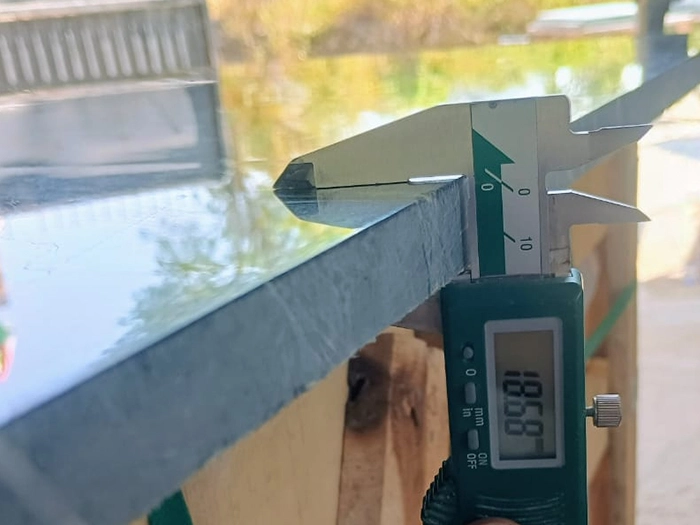
A practical green marble inspection checklist:
- Check full-slab photographs. Examine the entire pattern, not just a close-up of the surface.
- Confirm the material lot. Ask whether the approved sample and the production material come from the same block or a comparable quarry lot.
- Inspect visible defects & repairs. Discuss natural fissures, filled areas, resin treatment, and reinforcement where applicable.
- Verify dimensions. Confirm the required length, width, thickness & agreed dimensional tolerances.
- Review the surface finish. Check that polishing, honing, or other finishing methods match the approved sample.
- Plan pattern continuity. For feature walls & large floors, request slab sequencing or layout photographs when necessary.
- Confirm packing arrangements. Make sure the packaging method is appropriate for the stone dimensions and planned transport.
- Request the relevant documentation. Where necessary, obtain inspection records, available test reports, packing details, and shipping documents.
These checks are especially valuable when the selected material has extensive natural veining or when replacement slabs may be difficult to match later.
How to Clean and Maintain Green Marble
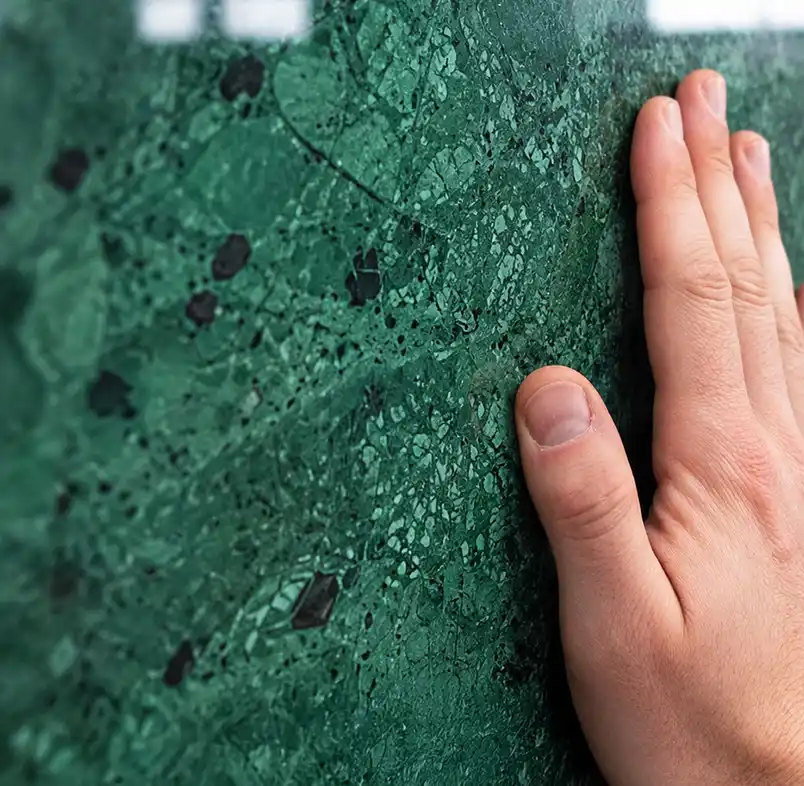
Green marble maintenance should begin with an understanding of the specific stone’s mineral composition and finish.
For routine cleaning, use a soft cloth or suitable mop with a pH-neutral stone cleaner.
Avoid harsh abrasive products and acidic cleaning agents unless their compatibility with the particular stone has been professionally established.
For countertops, spills should be cleaned promptly, especially when they involve oils, wine, citrus juice, or other potentially staining substances.
Whether the material needs sealing depends on its absorption characteristics, surface treatment, and intended use.
A suitable impregnating sealer may improve resistance to staining, but it does not eliminate the need for regular cleaning.
It is also important to distinguish between staining and etching.
Staining occurs when a substance penetrates or discolours the stone. Etching is a chemical change to the surface that can affect its appearance or polish.
Sealers do not necessarily prevent etching.
For long-term performance, follow the stone supplier’s recommendations and use maintenance products approved for the specific material.
Importing Green Marble from India: What International Buyers Should Know
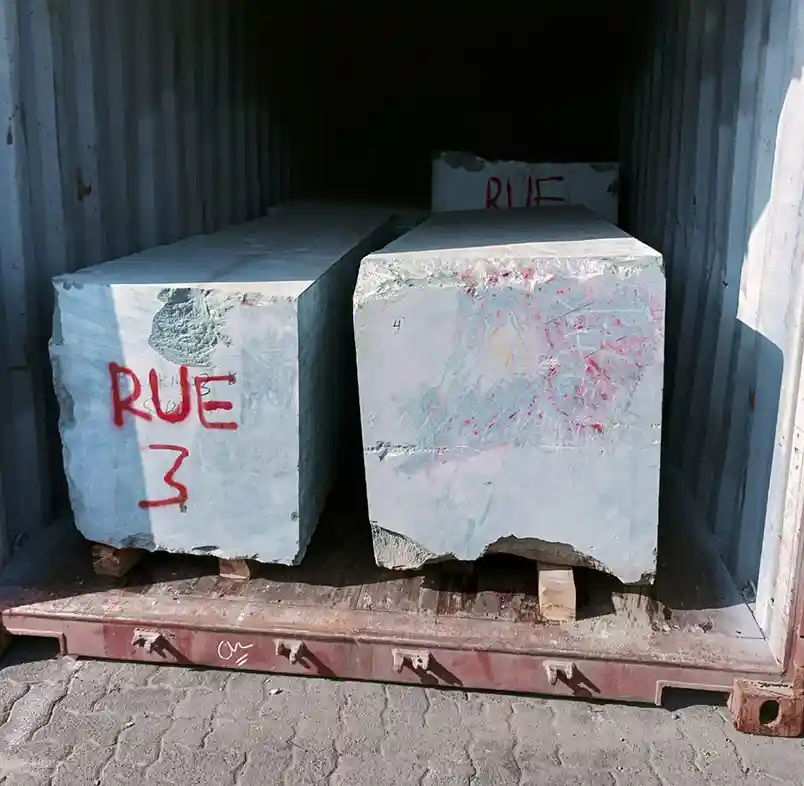
Importing green marble successfully requires clear communication between the buyer, supplier, and fabricator.
The process becomes easier when the required material is accurately specified before a quotation is requested.
A useful enquiry should identify the preferred marble variety, intended application, dimensions, thickness, finish, and approximate quantity.
For heavily patterned stone, include reference photographs showing the desired colour and vein distribution.
Buyers should also indicate whether they require random slabs, matching slab sequences, bookmatched panels, finished tiles, or cut-to-size components.
For export quotations, confirm the destination port or delivery location and the preferred shipping terms.
Lead times should be verified against current material availability and processing requirements. When requesting large quantities, it is also worth discussing the expected degree of colour variation and the approval process for the production lot.
These details reduce misunderstandings and help ensure that the supplied material meets the project team’s expectations.
Source Indian Green Marble with Regatta
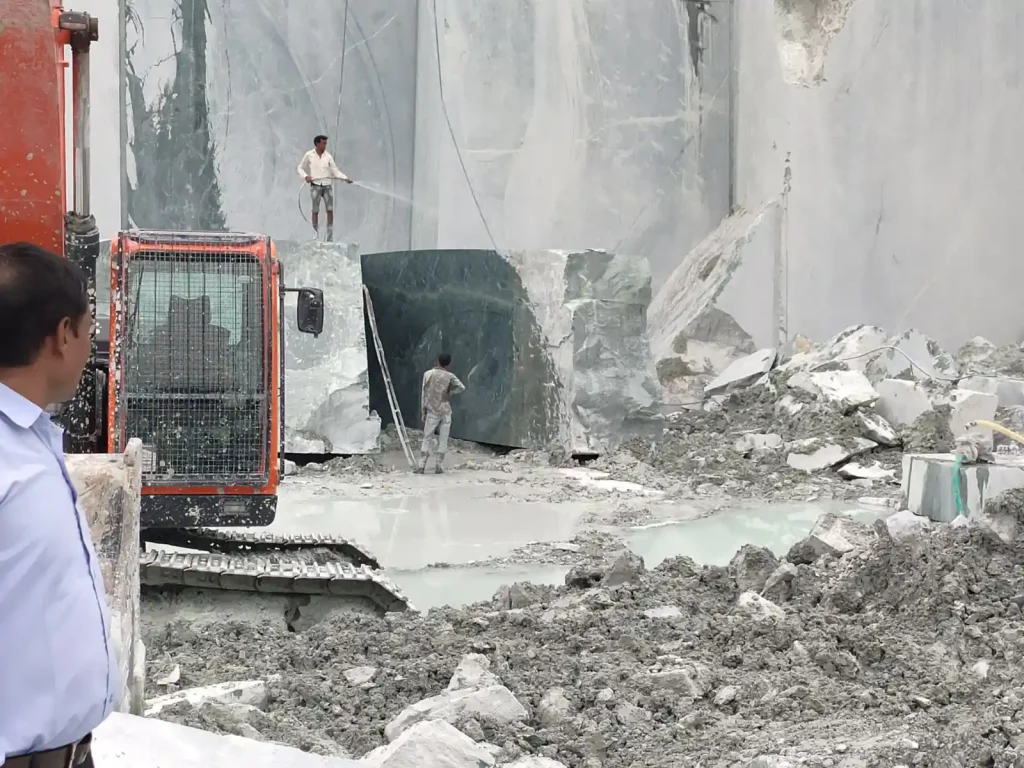
For international natural stone buyers, the right supply arrangement involves more than finding an attractive slab.
Reliable material selection, accurate processing, inspection, and appropriate export packaging all contribute to a successful order.
Regatta Granites India supports natural stone buyers through its established stone processing and export operations.
Its associated marble collection, presented through Regatta Universal Exports, includes Forest Green, Rainforest Green, Spider Green, Valley Green, and other decorative marble varieties.
Buyers can explore available products and discuss their specific requirements with the Regatta team.
Whether the requirement involves marble slabs for distribution, cut-to-size wall panels, or decorative stone for an architectural project, a detailed material enquiry is the best starting point.
Looking for green marble slabs, tiles, or customised natural stone products from India?
Contact Regatta with your preferred variety, dimensions, finish, quantity, and destination to request product information and a project-specific quotation.
Frequently Asked Questions About Green Marble
Green marble is a commercial category of natural decorative stone featuring green colouring and distinctive mineral patterns. Some varieties are true geological marbles, while others contain serpentine minerals and are classified differently in geological terms.
Popular green marble varieties include Forest Green Marble, Rainforest Green Marble, Spider Green Marble, Valley Green Marble & Himalayan Green Marble. Each variety offers a different combination of background colour, veining, and decorative characteristics.
Rajasthan is an important source of Indian green marble. The Udaipur and Dungarpur regions are associated with serpentine-rich green stones, while Bidasar is widely recognised for Rainforest Green Marble.
Selected green marble varieties are suitable for kitchen countertops. However, their suitability depends on various factors, including the material’s composition, resistance to scratching & staining, and maintenance requirements. Buyers/importers must confirm on these properties before finalizing any stone for the demanding kitchen environments.
Green marble prices vary according to variety, quality, dimensions, finish, availability & order quantity. Processing and international shipping requirements also affect the delivered cost. Buyers should request a detailed quotation based on their required specifications.
Neither material is universally better. Green marble is primarily chosen for decorative veining & visual impact, while green granite generally offers greater scratch resistance and is mainly preferred for demanding work surfaces. The best choice depends on the intended application.
Some green marble varieties benefit from sealing to reduce the risk of staining. However, sealing requirements depend on the stone’s mineral composition, absorption characteristics, finish & exposure conditions. A suitable sealer should be selected based on the actual material.
Certain green marble varieties may be suitable for exterior applications, but their performance must be evaluated for the specific environment. Freeze-thaw resistance, water absorption, weathering behaviour, surface finish, and installation conditions should all be considered.
The names are sometimes used interchangeably in the natural stone trade, although suppliers may list them separately. Buyers should compare actual slab photographs, quarry information & material specifications rather than assuming that differently named products are identical.
Begin by selecting the preferred marble variety & specifying the required size, thickness, finish, quantity, and destination. Share your list of requirements and other relevant details with a reputable Indian marble stone exporter to inquire about available options, production timelines, pricing, packing, and shipping arrangements.
Recommended internal links
For stronger topical relevance, add contextual links rather than placing unrelated links throughout the article.
| Anchor text | Suggested destination |
|---|---|
| Indian green marble varieties | Green Marble Collection |
| Forest Green Marble | Forest Green Marble Product |
| Rainforest Green Marble | Rain Forest Green Marble Product |
| Spider Green Marble | Spider Green Marble Product |
| Green granite varieties | Regatta Granites India Green Granite Collection |
| Natural stone quality inspection | Regatta Quality Control |
| Request a quotation | Regatta Granites India Get Quote |