
India doesn’t just participate in the global sandstone trade — it defines it. Market analysis puts India’s share of world sandstone exports at roughly 80% by volume and 85% by value, making it by far the dominant supplier to architects, landscapers, and contractors worldwide. For any importer researching sandstone exporters in India, understanding how this industry is structured — where the stone comes from, who processes it, and what separates a reliable sandstone exporter in India from a reseller — is the difference between a smooth supply chain and a costly sourcing mistake.
This guide breaks down the geography, the trade data, the manufacturing process, and the buyer checklist that matters most when sourcing Indian sandstone.
Sandstone Export from India: The Market in Numbers
Indian sandstone falls under HSN Code 25162000, a subcategory of the broader HS Code 2516 group, which also covers granite, porphyry & basalt. According to India’s Ministry of Commerce trade statistics, sandstone-specific exports (HSN 25162000) were valued at roughly ₹497 crore in FY 2024-25, a decline of about 16.61% compared to the previous year. Despite the year-on-year dip — a normal fluctuation tied to construction cycles in key importing markets — sandstone still accounts for close to 11.79% of the entire building-stone (HS 2516) category’s export value, ranking as one of the top-performing stone products under that classification.
Zooming out to the full building-stone category (granite, basalt, and sandstone combined), India’s exports were valued at around $616 million in 2023, a modest 5.68% decrease from $653 million in 2022. Even with this normal year-to-year variation, the category remained a significant share of India’s mineral exports, underlining how deeply the country’s dimension-stone industry is embedded in global construction and landscaping supply chains.
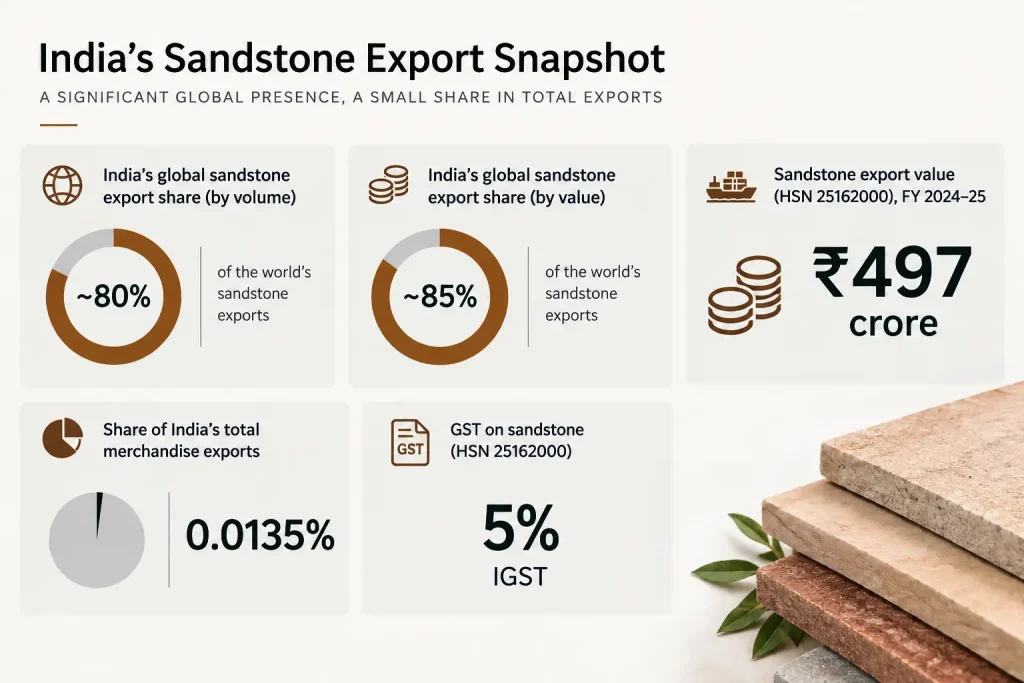
| Metric | Figure |
|---|---|
| India’s global sandstone export share (by volume) | ~80% of the world’s sandstone exports |
| India’s global sandstone export share (by value) | ~85% of the world’s sandstone exports |
| Sandstone export value (HSN 25162000), FY 2024–25 | ₹497 crore |
| Share of India’s total merchandise exports | 0.0135% |
| GST on sandstone (HSN 25162000) | 5% IGST |
That last figure — 0.0135% of India’s total exports — might look small, but it reflects a highly specialized, high-value-per-tonne category rather than a bulk commodity, which is exactly why buyer due diligence on individual Indian sandstone exporters matters more than chasing the lowest quoted rate.
Rajasthan: Where India’s Sandstone Manufacturers Are Based
Almost every serious conversation about sandstone manufacturers in India eventually leads back to one state: Rajasthan. Of India’s estimated 1,000 million tonnes of sandstone reserves spread across states like Madhya Pradesh, Gujarat, Uttar Pradesh, and Bihar, around 900 million tonnes — over 90% of the country’s total deposits — are concentrated in Rajasthan alone, spread through the districts of Bharatpur, Dholpur, Kota, Jodhpur, Sawai Madhopur, Bundi, Chittorgarh, Bikaner, Jhalawar, Pali, and Jaisalmer.
Geologically, this belt sits on the Vindhyan Supergroup, a sandstone formation that stretches from Chittorgarh in Rajasthan all the way to Sasaram in Bihar — one of the reasons Indian sandstone shows such consistent bedding, grain structure, and colour banding compared to stone from other countries. Within Rajasthan, processing and finishing activities are centered in a handful of towns: Dholpur, Karauli, Hindaun City, Sikandra, Bijolia, and Jodhpur, where most of the cutting, calibrating, and surface-finishing plants operate.
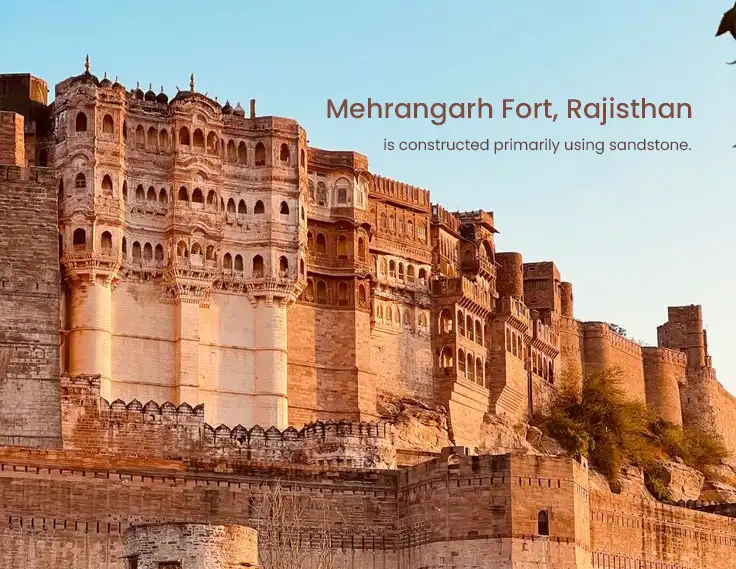
This isn’t a new industry riding an export boom — it’s a stone tradition with centuries of history. Indian sandstone has shaped some of the country’s most recognisable monuments, including the Red Fort, Fatehpur Sikri, the Parliament House, the Presidential House (Rashtrapati Bhawan), Mehrangarh Fort, and the Umaid Bhawan Palace in Jodhpur. That same material — quarried from the same belt, using the same geological formation — is what today’s exporters ship to patios in Surrey, driveways in Ontario, and courtyards in Bavaria.
From Quarry to Container: How a Sandstone Products Manufacturer in India Actually Works
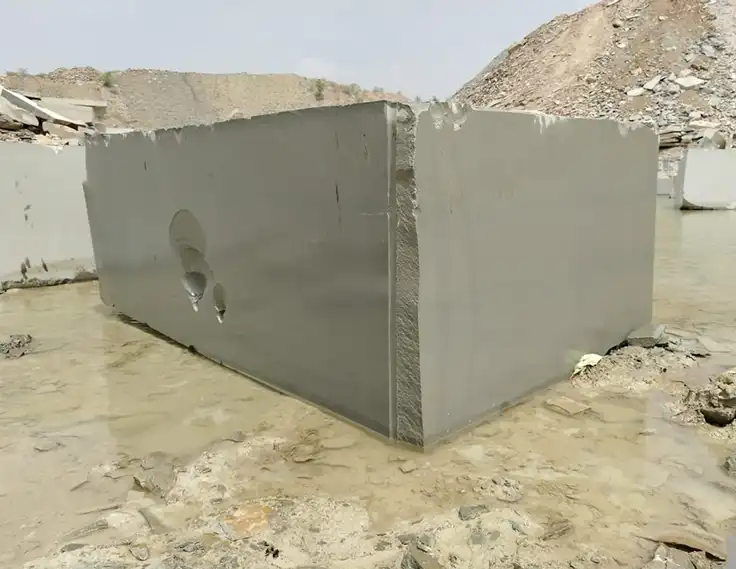
Not every entity calling itself an exporter owns the same part of the supply chain. Broadly, the industry splits into three roles as mentioned below:
● Quarry owners who extract raw blocks but often don’t have the finishing infrastructure
● Processing units that cut, calibrate, and finish stone sourced from various quarries
● Integrated manufacturers/exporters who combine sourcing relationships with in-house finishing, quality control, and export logistics
The second & third models tend to give buyers far more consistency, because colour matching, calibration tolerance, and surface finish are controlled at one facility rather than passed between subcontractors. At Regatta Universal Exports, this is the model we follow: sandstone is sourced from reputed quarries across Rajasthan’s producing belt, then cut, calibrated, and finished at our own facilities in Andhra Pradesh and Rajasthan — with quality checks applied before any block reaches the processing line, not just at the loading stage.
For buyers, this distinction matters practically. A sandstone products manufacturer in India that controls its own finishing line can guarantee batch-to-batch consistency in thickness tolerance and surface texture — something that a pure trading intermediary usually cannot.
Popular Indian Sandstone Varieties
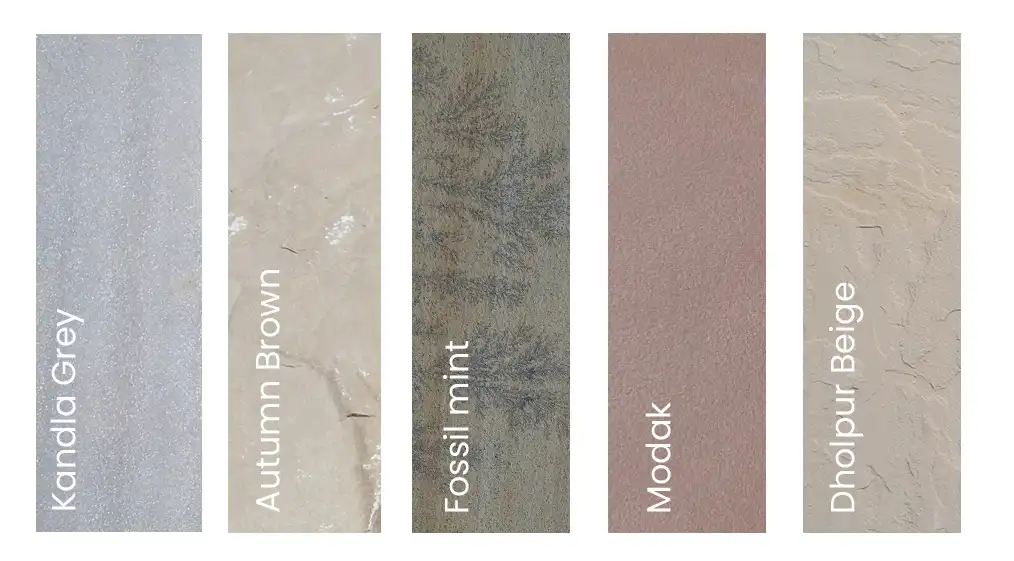
India’s sandstone belt produces one of the widest natural colour ranges of any building stone in the world, which is a major reason it dominates global exports. Commonly exported varieties include:
● Kandla Grey – a cool, uniform grey tone widely used in contemporary paving
● Autumn Brown – warm brown tones with natural variegation, popular for driveways
● Fossil Mint – pale sage-green with fossil veining, favoured in landscaping
● Teakwood – warm honey-brown, closely resembling timber decking
● Modak – multi-tonal buff and pink shades
● Rainbow – a striking mix of purples, greens, and browns in a single slab
● Dholpur Beige/Buff – classic warm beige, one of the most historically used building tones
At Regatta Universal Exports, our sandstone range at regattaexports.com/products/sandstone currently covers 25+ colour variants across these families — sourced, finished, and calibrated to match the specification needs of importers, fabricators, and landscape contractors across our core markets.
What to Look for in a Sandstone Supplier in India
With hundreds of companies coming up daily as sandstone exporters in India, buyers need a practical filter to identify a genuine, trustworthy supplier.
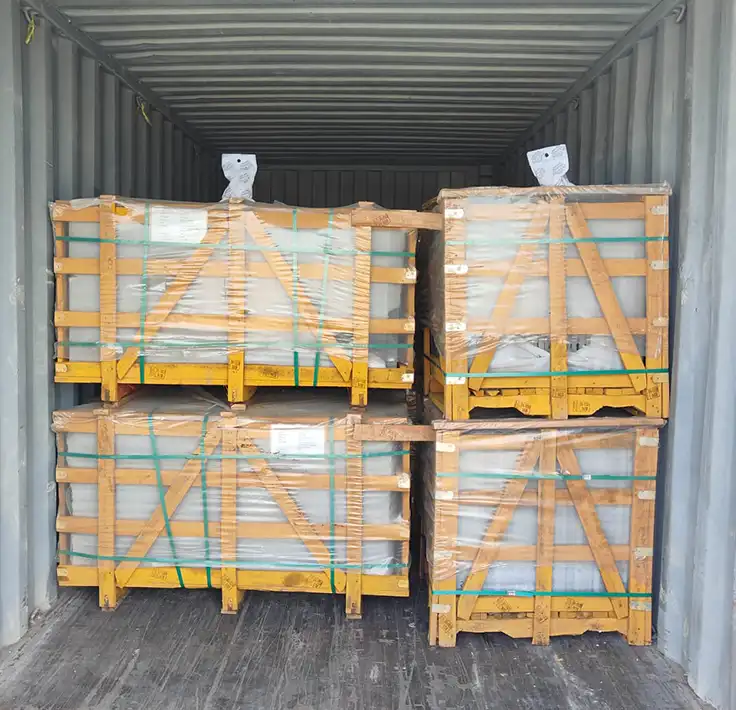
The most reliable signals of a genuine, export-ready supplier are:
1. Valid export registration — every legitimate exporter holds an Import Export Code (IEC) issued by India’s DGFT; ask for it upfront.
2. Export market compliance marks — CE marking matters for buyers in the EU/UK, while Xertifix Plus certification signals audited labour and ethical-sourcing standards, an area regulators in importing countries increasingly scrutinise.
3. Quality and management certifications — ISO 9001:2015 (quality management) and ISO 14001:2015 (environmental management) indicate audited, repeatable processes rather than one-off good batches.
4. Trade recognition — status such as a CAPEXIL member or a “One Star Export House” designation (awarded by India’s Directorate General of Foreign Trade based on sustained export performance) is a reasonable proxy for track record and shipment volume.
5. In-house processing capability — as covered above, a sandstone manufacturer in India with its own finishing facility offers far more control over consistency than a trading intermediary reselling third-party stock.
6. Sample-first policy — any exporter unwilling to send physical samples before a bulk order is a red flag, regardless of how polished their catalogue looks.
Regatta Universal Exports holds ISO 9001:2015, ISO 14001:2015, CE, Xertifix Plus, D&B, and CAPEXIL certifications, along with One Star Export House status — the combination our importer, architect, and contractor partners typically ask for during vendor onboarding.
Where Indian Sandstone Goes: Key Export Markets

Historical customs shipment data consistently projects the United Kingdom as the single largest destination for Indian sandstone imports, with one market study estimating the UK accounts for approx. 40% of India’s total sandstone export volume, roughly twice the volume shipped to the next-largest market, France. Beyond the UK, the United States, Germany, Belgium, and the broader EU account for the bulk of remaining demand — largely driven by patio paving, garden landscaping, and architectural cladding projects, where Indian sandstone’s natural riven texture & slip resistance are prized over other engineered alternatives that are available in the market.
This is also why most established exporters, including Regatta, calibrate product ranges, packaging formats (patio packs, project packs), and finish options specifically to meet the requirements of UK, US, and German landscaping and construction specifications.
Common Applications of Indian Sandstone
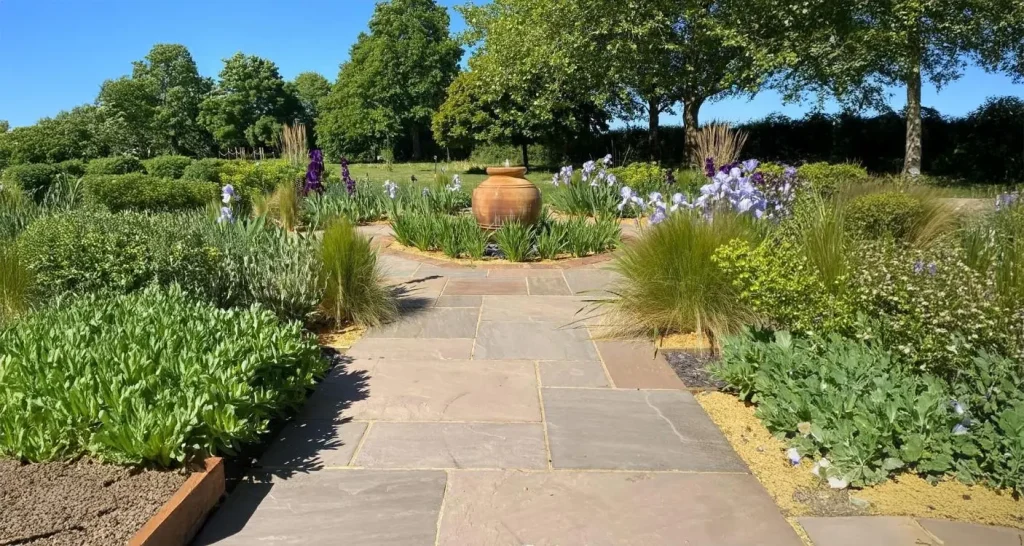
● Paving & Patios – riven or calibrated finishes for outdoor flooring
● Landscaping – steps, edging, walling & rockery features
● Flooring – honed or sandblasted finishes for interior/exterior floors
● Roofing Tiles – in traditional and heritage-style construction
● Wall Cladding – natural split or sawn-face panels for exterior facades
● Curbing & Kerbs – used extensively in civic and infrastructure projects
Frequently Asked Questions
Leading exporters are typically integrated manufacturers with their own quarry-to-finish processing, ISO/CE certifications, and multi-year export track records to markets like the UK, USA & Germany — rather than pure trading intermediaries.
Rajasthan, holding an estimated 90%+ of India’s sandstone reserves, concentrated in districts like Dholpur, Bharatpur, Kota, Karauli, and Jodhpur.
Sandstone is classified under HSN Code 25162000, a sub-category of the broader HS Code 2516 (granite, porphyry, basalt, and other building stone).
Yes — market analysis estimates India supplies around 80% of global sandstone export volume and roughly 85% by value, making it the dominant global source by a wide margin.
At minimum: a valid IEC (export registration), ISO 9001:2015, and — for UK/EU buyers — CE marking and Xertifix Plus for ethical sourcing compliance.
Sourcing Sandstone from India: The Regatta Universal Exports Advantage
With 25+ years in natural stone manufacturing and export, Regatta Universal Exports supplies sandstone, granite, and other natural stone to importers, fabricators, architects, and contractors across the UK, USA, Germany, and beyond — strictly on a B2B basis. Our sandstone is sourced from established Rajasthan quarries and finished at our own facilities in Andhra Pradesh and Rajasthan, backed by ISO 9001:2015, ISO 14001:2015, CE, Xertifix Plus, and One Star Export House credentials.
Browse our full sandstone range at regattaexports.com/products/sandstone, or get in touch for samples and bulk quotations